KINGDOM TRANSFORMATION – A REFLECTION

In Luke 17:20 we find Jesus saying: The coming of the kingdom of God is not something that can be observed, nor will people say, ‘Here it is,’ or ‘There it is,’ because the kingdom of God is in your midst, in response to a question from the Pharisees about when the Kingdom would come. Many around him, his closest disciples included, were anticipating the establishment of a kingly and earthly rule, along with an overthrow of the tyranny of Roman occupation.

Elsewhere we find Jesus likening the Kingdom of God to a mustard seed which grows into a tree so large that birds come and nest in it, and to yeast mixed into a large quantity of flour until all of the flour is affected (Matt 13:32,33; Luke 13:18-21). The seed needs to be planted in the ground so that it will grow. The yeast needs to be worked into the flour so that the resulting dough will rise. In both cases something which is already in the midst, is activated to accomplish its purpose.

Some time ago a short animation was a popular evangelistic tool. It depicted a cartoon character going about his every day life, doing whatever he wanted and thinking that all was well with him and his world. Almost unnoticeable in the background, but visible in every frame, was an ill-defined blob. As the story progressed and its subject encounters several of life’s challenges, the blob becomes more and more an unwanted and embarrassing presence. Toward the end the cartoon character begins to realize he cannot live life without help. At that point the blob resolves into a form of the cross.

In the same way this is what the Kingdom of God is like in the world. It is the presence and power of God waiting patiently to be activated by His redeemed creation. It is also the presence and power of God intended by the power of His Spirit to convict the world about sin and righteousness and judgment. It is the presence and power of God lived out through one such as the early twentieth century Pentecostal pioneer Smith Wigglesworth who once took a seat in a railcar when a man seated across from him blurted out: Your presence convicts me of sin.[i] Wigglesworth then led him to the Lord.

Some would tell us that the Kingdom comes about because God’s people take power, redeem the institutions of state and then use them to bring the Kingdom into reality. This approach has been seen in the activity of some Christian political movements from both the right and left wings of the political spectrum. Outside Christendom a present example would be the Islamic State, which through the establishment of an Islamic hegemony, exerts absolute authority over the people in an endeavor to establish Theocratic rule. But surely a top-down approach to Kingdom building like this does no more than repeat the mistake of the early church in its alliance with the State following Constantine’s declaration of Christianity as the official religion of the Roman Empire.

Others working at grass-roots level would liken the Kingdom to a type of fifth-column.[ii] They want to found a movement, which grows to encompass and overtake diverse aspects of a society transforming them into the Kingdom of God.

Whether by imposition or by insinuation both of these approaches endeavor to change something already existing into the Kingdom of God. I don’t doubt that human institutions can be changed; indeed throughout history some have been changed. However the idea that the Kingdom of God results merely from the transformation of humanity’s corrupted history, flowing into the present shape of the nations, seems to me somewhat limiting of the power of God. Just as Jesus’ call to discipleship is a call to a radically different lifestyle, not to be equated to the lifestyles of rabbinic followers of contemporary Jewish leaders, so the coming of the Kingdom of God extends a possibility radically different from the redemption of human institutions. The mustard seed grows to become a huge tree, not dependent upon the support of surrounding structures. It becomes so large, lush and fruitful that birds come and nest within its security. The tree offers a radically attractive alternative to all the other trees the forest has to offer. In the same way the yeast works through inert flour to grow fresh dough that can be used to bake bread. If the flour is corrupt to begin with the yeast will not restore it. Bad dough will result, and with it, bad bread.[iii]

Wherever we find ourselves in ministry – whether church-planting in a modern city, or sharing Jesus’ love among nomads on the edge of desert; whether growing a business that expresses the values of God’s Kingdom, or engaging a community through the power of the creative, let us remind ourselves that the Kingdom is within our midst. Let us live our lives so that through us, and through the community of believers to which we belong, the light shines strongly, people see our good Kingdom works, and they are thus drawn to praise our Father in heaven.

The Kingdom of God is present in our midst, because God is present with His people, desiring for them to offer the world the kind of alternative that is embarrassing in its simplicity, convicting through its presence, and radically secure in its demands. May His Kingdom come!

[i] Quoted in Chapter 14 of Derek Prince – Transformed for Life: How to Know God Better and Love Him More – Chosen Books 2002

[ii] The fifth column is a term originating in the Spanish Civil War and applied to those inside the siege of a city, allied to the besiegers who could bring about its downfall from within.

[iii] Research into a cause for the strange behaviors that led to the 1692 Salem Witch Trials in the Massachusetts colony explored the possibility of members of the community being poisoned by bread produced from a crop of rye contaminated with ergot. See Linnda Caporael – Ergotism, the Satan loosed in Salem – http://www.physics.smu.edu/scalise/P3333sp08/Ulcers/ergotism.html   – accessed September 5, 2016

Posted in Teaching and Meditations | Tagged | 1 Comment

Divide

During a summer trip to Tennessee with the family we drove Interstate 81 down Virginia’s Shenandoah Valley. Along the way we passed the sign which states: “Extent of the Chesapeake Bay Watershed”. I pointed out to the kids that we were passing the point at which all the rain falling behind us (as we drive Westward) should ultimately flow into the Chesapeake Bay and out into the Atlantic, whereas all rain falling ahead of us should flow into the Ohio river system and from there through the Mississippi River to the Gulf.

So, a few weeks later when Jill and I were in Colorado and staying near the little town of Divide my thoughts turned to the Continental Divide of the great Rocky Mountains, the back bone, if you like, of the North American continent. Divide itself is not technically the watershed; that comes a few miles further west at Hoosier Pass, however for the most part, all the precipitation east of Divide will flow either into the Gulf or through the Great Lakes to the Atlantic, while everything falling to the West will flow into the Pacific. There could not be a starker difference between the directions which gravity forces one drop of water to take!IMG_3450

We were on retreat. We were taking time away from work, family and everyday Virginia life, for rest, reflection and prayer. We felt very blessed as we explored, hiked, enjoyed good food and shared fellowship with the three other couples staying at the retreat center. We were also in a land of profound differences. Our retreat was hosted in a lodge hidden away in a quiet forest of ponderosa pine and aspen while down the highway just a few thousand feet below us were the tourist hubs of Woodland Park and Manitou Springs. We enjoyed beautiful clear days with warm summer temperatures, aware that winter brings blizzards and weeks of frozen landscape. When we went to the top of the 14,000 foot (4,200 meter) Pike’s Peak we experienced the immediate transition from lush green forest to barren landscape when we emerged above the tree line. And from the top we witnessed the contrast between a clear blue sun-washed distance, and angry dark thunderheads pouring rain within the atmosphere, while little flecks of snow drifted over us.

Many of our friends and colleagues around the world are affected by strife within their nations. Even as the Olympics bring the world together in Rio, our Brazilian friends live with the impact of the impeachment process of their president. Venezuelans live with a bankrupt economy, while the French grieve over senseless violence, and our friends in Turkey are unsettled both by war to the south and the aftermath of an attempted coup. Britain’s European Union exit vote affects the whole continent and here in the USA many are pondering how an election primary process could have produced two equally unacceptable candidates for Presidential office. The divide within many communities is apparent. Surely in darker times, there is an opportunity for the church to renew Jesus’ offer to the world of the light of the gospel.

The writer to the Hebrews tells us that: The word of God is alive and active. Sharper than any double-edged sword, it penetrates even to dividing soul and spirit, joints and marrow; it judges the thoughts and attitudes of the heart. (Hebrews 4:12) These words remind us of the offence of the Gospel. There is a God in heaven who is audacious enough to tell us how we are to live. No, he is not audacious, he simply IS! The I AM is the creator God. The right to tell His creation how it is to behave requires no audacity. But regrettably, we are living in a society that always wants to blur the lines; a world that does not want to admit the stark divide between the Kingdom of Light and the kingdom of darkness. Regrettably we find this not only in societies where we would expect it but also within churches that profess the truth but live a lie. Sin has become an issue for pastoral accommodation rather than pastoral care; issues of social and religious injustice are excused; and Jesus’ Great Commission to preach the gospel to every nation often remains ignored.

Divide in Colorado denotes a place from which gravity determines which way the rivers flow. However gravity does not determine the choices of the follower of Christ. His choice does not have to be subject to the prevailing social winds. The divide for him must be grounded in the unchanging and eternal word of God.

Posted in Family News, Teaching and Meditations | Tagged , | Leave a comment

A RESURRECTION MESSAGE

On Good Friday Jill and I took Sarah Grace on a journey to the cross. Our local church in Richmond designs a creative experience telling the story of Jesus’ last hours.

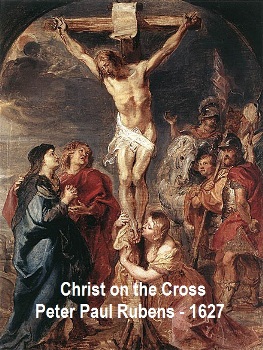
On this occasion one of the final scenes shows a series of paintings of the crucifixion from the Great Masters projected onto a white screen. As I sat in the still, quiet sanctuary viewing a sequence of work from such as Michelangelo, Caravaggio, Rembrandt and Peter Rubens Christ on the Cross - small

Paul Rubens, I realized they have all seen the one whom they depict. Men, long dead, have passed beyond this world to where their relationship with God has taken them. Freed from time’s constraint they have looked upon the face of the Lord. They have seen the reality on which their earthly art could only speculate, and in a sense, they have seen the result of faith that had previously only found its form from an artist’s palette.

God speaks His word to us through the prophet Zechariah (12:10): They will look on me, the one they have pierced, and they will mourn for him as one mourns for an only child, and grieve bitterly for him as one grieves for a firstborn son. On the day of the cross we look upon Him who our own actions have slain, and we recall all that He has done for us. We also look forward to a celebration on the Sunday that we call Resurrection Day.

Resurrection from time’s perspective is all about faith. The writer to the Hebrews tells us that the great men of faith who preceded the coming of the Christ, (Heb 11:13) were still living by faith when they died. They did not receive the things promised; they only saw them and welcomed them from a distance. They were all commended for their faith, yet none of them received what had been promised, since God had planned something better for us so that only together with us would they be made perfect (Heb 11:39-40).

What are we looking for in living the Christian life that we have not yet seen? For some it may simply be the salvation of a loved one; for others it may be a strategic advance of the gospel among an unreached people group. How do we view the unseen? With a hint of wishful thinking or with impassioned desire borne of vision shaped by God’s word to us?

The painters of the cross give us glimpses of the suffering of Christ. The artists of the Resurrection present mere mortal interpretations of glory. It is for each of us to lay out a path, through prayer and action, toward what we embrace in faith. But having defined it, we live and work according to the word we have received. And as we take our life and our work to the cross we see His will accomplished through resurrection life.

Posted in Family News, Teaching and Meditations | Tagged , | 1 Comment

WE NEED A NEW CONTRACT WITH AMERICA – CAN WE HAVE IT IN NO TRUMPS PLEASE?

Anyone familiar with the game of Bridge knows that players can play for a contract in which clubs, diamonds, hearts or spades are trumps, ranking higher than any other cards. Or they can settle for a contract in No Trumps where all cards rank in order and no suit is higher than another.

Twenty-two years ago the Republicans gave America a Contract [1], one which they then set about fulfilling. America is in need of a new, but “No Trumps” contract, and, if we can choose another suit, let it not be the “pale blue pantsuit” of a Clinton, successor to the “dark gray three-button” of her husband!

It seems that there are many on both sides of the political spectrum who are tired of the current state of affairs in America and long for something new. The hung over effects of the recession mean that many in the middle and lower end of the earnings spectrum are frustrated by the lack of real growth in incomes. At the same time jobs lost in recent years have been replaced by many more part-time opportunities with fewer benefits. Frustration with political gridlock in Washington, combined with anger at the incumbent’s policies ranging from healthcare to gay marriage and to the impasse over immigration policy, has rallied around a political outsider and the most socialist politician ever to serve in Congress. The former is a millionaire businessman, whose news-making abilities have previously lent themselves to the entertainment tabloids; the latter is an ageing hippy. Both would serve as the oldest to be elected in the history of the American presidency.

The primary election system for the choosing of a presidential candidate appears incomprehensible to the average outsider. Each state has its own rules for the method of voting, and for the allocation of delegates to the national political conventions that choose the party candidate. Each state is free to set the date for its own voting. So, we have the Iowa caucus and the New Hampshire primary to kick off the long season. Sometimes these predict the direction of the rest of the selection process, sometimes they do not. However, there is no doubt that they preview one of the longest of election processes anywhere.

When Donald Trump entered the race for the Republican nomination last year, the Republican establishment did not take him seriously. However there were too many other candidates to allow opposition to Mr. Trump to coalesce around an alternative. At one point there were seventeen candidates. 30% of the way through the process Mr. Trump is the frontrunner, yet his two closest rivals, Senator Cruz from Texas and Senator Rubio from Florida, have between them accumulated a greater number of delegates. More Republican primary participants have not voted for Mr. Trump than for him!

Mr. Trump, or ‘The Donald’, as the entertainer side of him has become known, is a larger than life character. His Wikipedia entry states: His branding efforts, career, outspoken manner, personal life, and wealth have made him an international celebrity.[2] His TV show, The Apprentice, running since 2004 for seven seasons in the original version and another seven in the celebrity edition, has introduced his no-nonsense business style to the American public. On the campaign trail his brutal blend of bluster and braggadocio has ensured that he can keep hitting the headlines with outrageous statements.

It is one thing to be arrogant and pompous. It is an escalation to be proud of being proud! Do we really want a major party candidate, let alone President who says such things as: I could stand in the middle of 5th Avenue and shoot somebody and I wouldn’t lose voters;[3] Look at that face! Would anyone vote for that? Can you imagine that, the face of our next president;[4] and The wall will go up and Mexico will start behaving.[5]? Do we really want a President who has impressed his image on our national consciousness by pointing a finger across his desk and saying: “You’re fired!”? [6]

However, if we look to the other side of the aisle, what better choices do we have? I am sure that Mr. Sanders is a nice guy, but America has never been a socialist nation. President Obama came up with a great plan for ensuring everyone could get affordable healthcare. For many people the plan just increased the cost of their insurance. Bernie plans to make college free for all undergraduate students. It’s one thing to offer to make things affordable, it’s another to have courage to tackle the reasons why the building block services of our society, such as healthcare and education are so expensive!

That brings us to Mrs. Clinton. Mired in scandals that would have had the media all over a Republican candidate, she has brushed off the problems with Benghazi, and her email server, to ride a wave of misplaced popular acclaim. Let’s not forget that her husband won the Presidency with 43% of the vote in 1992. If Ross Perot had not filtered so many votes away from incumbent George Bush it is doubtful whether Mr. Clinton would have made it to the White House. His presidency was the most scandal-ridden of the last forty years culminating in his 1998 impeachment. Mrs. Clinton rode his coat-tails into political office, first as Senator for New York and then as Secretary of State in the first Obama administration. It is hard to see what her route to either of those offices would have been had she not been the wife of a former President who remained popular with his own party. The history of investigations into her business affairs during her husband’s Presidency and as a result of her position as Secretary of State should, at the very least, give us all a concern about her personal judgment.

But what choice do these candidates really leave us with? The best candidates of this campaign, those who have actually held executive office as governor of a state are falling by the wayside. Scott Walker from Wisconsin for the Republicans and Martin O’Malley from Maryland for the Democrats withdrew a long time ago. We are left with Mr. Kasich of Ohio, who has served his state well, has even won his state primary, but trails far behind the Donald.

Maybe Mr. Trump really believes he can run a nation – he ran some of his businesses into bankruptcy; the United States is already bankrupt! Maybe he only got into the race because he was determined that Hilary would not be the only candidate who could have a bad hair day! At least he is right when he says: She shouldn’t be allowed to run. If that were a Republican that did what she did with the emails they would have been in jail twelve months ago. Clink! [7]

[1] The Contract with America was a document released by the United States Republican Party during the 1994 Congressional election campaign. It detailed the actions the Republicans promised to take if they became the majority party in the United States House of Representatives for the first time in 40 years. See also http://www.heritage.org/research/lecture/the-contract-with-america-implementing-new-ideas-in-the-us (accessed March 11, 2016)

[2] https://en.wikipedia.org/wiki/Donald_Trump (accessed March 4, 2016)

[3] Stated at a Campaign event in Sioux City, Iowa, January 23, 2016 – http://www.theguardian.com/us-news/2016/jan/24/donald-trump-says-he-could-shoot-somebody-and-still-not-lose-voters (accessed March 4, 2016)

[4] Speaking of Carly Fiorina, a former candidate, during an interview on September 9, 2015 – http://www.telegraph.co.uk/news/worldnews/donald-trump/11855165/Trump-on-Fiorina-Look-at-that-face.-Would-anyone-vote-for-that.html (accessed March 4, 2016)

[5] Speaking on the Bill O’Reilly Show – June 16, 2015

[6] The weekly elimination of a candidate from his show “The Apprentice!”

[7] Speaking at a rally in Norcross, Georgia, October 10, 2015 – http://www.wmur.com/politics/donald-trumps-most-provocative-quotes/34313688 (accessed March 16, 2016)

Posted in Culture and Politics, Nations, Politics | Tagged , , | Leave a comment

Ashes to Ashes & Dust to Dust – A Lenten Reflection

When you believed, you were marked in him with a seal, the promised Holy Spirit

– Ephesians 1:13 –

Earlier this month Jill and I said goodbye to her uncle. JE had lived all his eighty-eight years on the land. A lifelong bachelor he had farmed the same land, first with his father, and then on his own since before the Second World War. We called his land The Farm on Lake Anna, however he had lived long enough to remember before the lake existed. He was a Virginia gentleman, quiet and strong. His hands were calloused with the marks of his labors. He loved his animals, he loved children, and he loved his Lord. His funeral took place in Gordonsville after which he was interred near his parents in a cemetery in Louisa. From the dust of the earth he came, with the dust of the earth he lived and worked, and to the dust his mortal remains return.

Wednesday this week was Ash Wednesday and we went to a service of worship at church. Ash Wednesday is the first day of Lent. Following Shrove Tuesday or Mardi Gras, when many Christians of days gone by used up the remainder of their ‘rich’ foods, the church enters a period of reflection and fasting during the weeks leading up to Good Friday. Jill and I both grew up in the Free Church tradition which places far less emphasis on the High and Holy days than the liturgical tradition. Among many of our fellow Presbyterians I suspect the conduct of Wednesday’s service was a new experience. However, an intentional focus upon sin, a call to repentance and a personal sense of contrition were a powerful prelude to the burning of our confessions written on paper, followed by marking with the resultant ash upon each forehead. It was precious to watch our kids embrace the moment. The nearby font provided a welcome reminder that the waters of baptism are a sign that our sins are washed away, just as water will wash away the ashes of the marks of contrition on a forehead.

The mark on my own forehead served as a reminder of my sin. It then confirmed my powerlessness to do anything about that sin, other than rely upon the grace of Jesus expressed upon the cross. It also inspired another thought.

Muslims like to bear a mark upon their foreheads. There have been many times when I have noted the dark mark emphasized in the middle of the brow of a Muslim, looking something like a bruise. For some the mark has become calloused as they intentionally press their foreheads hard to the ground in the ritual of prayer. The position known as sajdah requires the praying Muslim to place hands, knees and forehead upon the ground as he states: Allah-Akbar – God is Great. Some will wear this mark as a mark of pride, boasting in the dutifulness of their devotion to God in prayer. Others will try to avoid such a marking lest they be considered prideful. Either way however, the actions of a devout Muslim are an endeavor to reach God by gaining his pleasure. The mark is a symbol of his own efforts, as through good works and right guidance a Muslim hopes to gain eternity.

Hindus also like to bear a mark upon their foreheads. The Bindi or ornamental red dot upon the forehead is representative of the third eye and associated scientifically with the pineal gland. However, the Bindi is also the symbol of all unity marked where the third eye represents the seat of concealed wisdom. It is intended to focus the concentration of the mind, and lead the bearer into unity with all things. From the times of the Vedas, the Hindu scriptures, dating back 3,000 years, the Bindi was created as a means to worship one’s intellect, to ensure that one’s thoughts, speech, actions and character become pure. It thus represents human striving for perfection. The mark becomes a symbol of the Hindu’s quest to become one with the eternal.

The Apostle Paul, writing his great theological treatise of Christian experience to the people of Ephesus, tells us that when we first believed in the saving work of Christ, he marked us as his own with His Holy Spirit.

My wife’s uncle faithfully served God in rural Virginia. He was laid to rest in the dust of the land, not needing to rely upon anything to see God other than the cross of his Lord and Savior. The ashes, representing our sins in this Lenten season before that cross, are dust in another form; the dust of death, washed away by a Savior before whom all our works count as nothing; a Savior who has replaced the marks of our sins with the anointing mark of His Spirit. We need no other mark upon us.


Posted in Family News, Islam, Missions, Teaching and Meditations | Tagged , , , | Leave a comment

THE BANQUET

Europe is currently facing the largest migration of peoples since the Second World War. Many of those who are coming to Europe are displaced from Syria by the civil war there and the depredations of the Islamic State. However there are others from nations like Afghanistan and Eritrea that have been destabilized by Islamic militancy or the style of an African dictator.

Throughout the year the media has been filled with horrific stories of human suffering as overloaded boats of refugees capsize in Mediterranean waters and groups of migrants are turned back at European border crossings. In some places churches are actually praying that God will protect their nation from the threat of migrant Muslims. But a prayer against the perceived threat, misses the opportunity that the Lord is presenting to the church.

Oppressed are being set free from Political and Religious regimes under the most horrific of circumstances. Walking across international boundaries carrying what little they can salvage from their previous lives, they are being rejected by the peoples of the free lands to which they have arrived.

Yet in Liverpool, England, Iranians are coming to faith and rejecting the Islamic interpretation that has made their homeland a place of oppression. In Germany and Spain Christian communities are preparing to receive refugees into the towns where they worship and witness.

In Richmond, Virginia, families that came for university study have unwittingly become refugees because their home city of Mosul, Iraq has been overtaken by Islamic State. In Ankara, Turkey, refugees from Syria are being fed and offered other forms of practical assistance in an endeavor to build a new life.

At the same time with more than half the Syrian population displaced by Civil War, multitudes living in camps in Jordan, Lebanon and across the Turkish border are wondering what the next stage of their suffering will involve.

Jesus once told a story to a group of people with whom he was eating supper:

“A certain man was preparing a great banquet and invited many guests. At the time of the banquet he sent his servant to tell those who had been invited, ‘Come, for everything is now ready.’

“But they all alike began to make excuses. The first said, ‘I have just bought a field, and I must go and see it. Please excuse me.’ Another said, ‘I have just bought five yoke of oxen, and I’m on my way to try them out. Please excuse me.’ Still another said, ‘I just got married, so I can’t come.’

“The servant came back and reported this to his master. Then the owner of the house became angry and ordered his servant, ‘Go out quickly into the streets and alleys of the town and bring in the poor, the crippled, the blind and the lame.’

“‘Sir,’ the servant said, ‘what you ordered has been done, but there is still room.’

“Then the master told his servant, ‘Go out to the roads and country lanes and compel them to come in, so that my house will be full. I tell you, not one of those who were invited will get a taste of my banquet.’” (Luke 14:16-24)

I wonder if the European church is experiencing a banquet moment at present. There are three things that happen here. Firstly, there is an invitation; the invitation is rejected. Then there is a bringing in, and finally there is a compelling to come.

Across a post-Christian Europe that is increasingly secular, Christ’s invitation to come has been rejected. The gospel and the church are deemed irrelevant; their life and opportunity construed meaningless in a technological and scientific world where fundamental questions are deemed unanswerable. The establishment has abandoned the religiosity that made church attendance a socially acceptable activity in the last century, and the plurality of other faith expressions that have been absorbed with successive generations of migration to Europe, has watered down the appreciation of a Christian heritage.

And yet on the fringes of society the marginalized have found faith. While the church in Spain among the ethnic Spaniard has gone into serious decline, it has grown among the newly immigrant Latin-American community and among the outcast gypsies. In the German town of Hahne a traditional Lutheran congregation of only a handful opened its facilities to an international congregation of migrants from more than fifteen nations. Thirty representatives of the traditional society host more than a hundred of the newcomers. At the same time immigration from Africa and the Caribbean energizes congregations in France.

The encouragement from Jesus’ parable is to bring in the marginalized, and then somehow to pray that those beyond human reach be spiritually compelled to come in. Ministry to refugees, as with all Christian ministry is a calling to love. Love for neighbors; love for enemies; love in the Spirit of Jesus Christ’s love. We are to feed the hungry, clothe the naked, shelter the homeless, and practically provide the kind of assistance that makes a new livelihood possible. At the same time, and without condition, or compulsion, we can make the Good News of Jesus Christ understandable, believing that in the midst of tragic displacement, God still offers redemption through his Son and the banquet He has prepared for all.


Posted in Culture and Politics, Missions, Nations, Teaching and Meditations, The Church | Tagged , , , | 2 Comments

BEYOND HUMAN CONTROL

At least 769 people died in a crushing stampede at the annual Hajj at Mecca last month. Various voices elsewhere in the Muslim world, most strongly spoken by the Iranian government, have accused the Saudi authorities of negligence. Meanwhile, the Grand Mufti of Saudi Arabia, the nation’s highest official of religious law, defended the authorities saying the stampede was “beyond human control”[1]. Including the collapse of a crane earlier in this year’s Hajj season, which killed 109 people, there have been a succession of disastrous events over recent years during this season of pilgrimage which have cost several thousand pilgrims their lives.

The Hajj is “the pilgrimage that every able adult Muslim should undertake to Mecca at least once in his or her life”[2]. It is one of the five duties of a good Muslim and, as a spiritual duty might most closely equate to a pilgrimage to Jerusalem, to a well-known Cathedral, or to a place of spiritual retreat that a Christian might undertake. Every year more than two million make the main Hajj to Mecca as they travel from all around the world to participate in this unique and special experience for the faithful Muslim. The Hajj always takes place on the same days during the last month of the Muslim calendar, and it therefore places huge stresses upon the resources of the city of Mecca and the nation of Saudi Arabia.

The Hajj involves a number of rituals including walking seven times counter-clockwise around the Kaaba, the central symbol of Islam; drinking from the well of Zamzam, believed by Muslims to be the water source that Hagar was shown in the desert when she and her son Ishmael were thirsting; and a symbolic stoning of three pillars representing Satan, at the Jamarat Bridge in Mina, a district of Mecca. During this latter ritual crowds flow along the bridge past the three pillars which are shaped as walls. They throw stones at these pillars and the stones then fall down through holes below the wall to prevent an accumulation of stones preventing others from their participation. It was during this ritual as two columns of people merged onto the bridge that the stampede and crush occurred, resulting in the deaths and injuries to so many participants.

Many of us in the evangelical tradition find ourselves puzzled by the enthusiasm of so many who, assuming they can afford it, make this journey. We may similarly be amazed at the crowds that throng to a special Hindu festival in India or endeavor to see a Pope on the occasion of his visit to their land. Even though many may make a journey to the Holy Land or specifically to Jerusalem we recognize with Abraham that we are looking for the city which has foundations, whose architect and builder is God, which is the Heavenly Jerusalem[3]. We are on a spiritual pilgrimage and not a physical one to a shrine or monument.

We are probably also shocked by remarks of a senior Muslim leader that seem somewhat callous. How can someone say that events like this are beyond human control? The Saudi authorities have invested huge sums in infrastructure and safety measures to ensure that the events of past years were not repeated. They even replaced the stone pillars representing the devil with stone walls giving more space for passing pilgrims to throw their stones accurately. Many other measures could be taken to ensure that free-flowing masses of people do not collide and crush one another. While the queue or the line, so beloved by patient Anglo-Saxon societies is rarely found in other parts of the world, the snaking barrier systems used for border controls, entrance to public buildings and fun-fair rides, are easily implementable elsewhere. And for a Muslim authority adept at issuing rulings over Islamic Sharia, when Qu’ran and tradition have nothing to say about the modern world, it would surely be easy to make the Hajj into a year-round possibility like the Umrah, or lesser pilgrimage to Mecca. This would reduce the huge numbers traveling to Saudi Arabia for the one specific annual season. Hajj is not like the Christian Christmas and Easter which can be celebrated anywhere.

The statement beyond human control, as used by a Muslim Imam, surely reveals more about Islamic ideas of the will of God. According to Sharia a Muslim intending to do something should always add the words: Insha’Allah – If Allah wills it [4]. This attitude has induced such fatalism into Islamic society. I remember a doctor telling me the story of sitting with a Tuareg mother in the West African Sahel and watching her baby slowly die in her arms because Allah willed it. A clinic was within reach, and resources for medical care were available, but the mother would never initiate an active pursuit of healing when prayer and the local marabout (Muslim holy man) were not providing a solution, because Allah willed the death of her child. The value of a human life will never be understood without the knowledge of the true God of creation, love and purpose.

The Arab world was a backwater in modern history with relatively little impact on the rest of the world until the discovery of the vast reserves of oil under the Arabian sands. The wealth derived from that resource coupled with resistance to the State of Israel propelled the Middle East into the consciousness of the Western world. However a hard look at the years of Arab history shows little historical contribution to the industrial and technological age. Despite the ancient Golden Age of Islam, half a millennium passed with very little contribution from the Muslim world while Western advance shaped the civilization of Christendom. Where in history are the Muslim inventors, industrialists, businessmen and philanthropists shaping our world. Modern wealth derived from oil has certainly had an impact, however as the last half century has revealed, that wealth has also had a huge impact in the realm of Islamic-inspired terrorism.

I would suggest that the attitude of Insha’Allah has induced the kind of historical passivism that results in things beyond human control. Works based on the fear of Allah will never be as effective as those rooted in the knowledge of an heavenly Father’s love and the resulting love for His creation.


[1] Saudi Mufti: Hajj stampede beyond human control – http://www.aljazeera.com/news/2015/09/saudi-grand-mufti-hajj-stampede-human-control-150926080554917.html – accessed 29th September 2015

[2] http://berkleycenter.georgetown.edu/essays/islamic-practices – accessed 27th September 2015

[3] Hebrews 11:10 & 12:22

[4] “And never say of anything, ‘I shall do such and such thing tomorrow. Except (with the saying): ‘If God wills!’ And remember your Lord when you forget…'” Qu’ran 18:23-24

Posted in Islam, Nations, Teaching and Meditations | Tagged , , , | Leave a comment

The Church in Britain – Three Days, Three Perspectives

I’m in Britain with my family for a few weeks. As a Brit and an ex-pat, living overseas for more than twenty years it has been a privilege to drop in on the church scene in the United Kingdom now and again. I know quite a number of church leaders across the spectrum at the grass-roots level so it’s always good to be able to get some perspectives from those who serve full-time within church and community. I’ll share three of those perspectives from three successive days in June.

On Friday 19th June we had the opportunity to be in Oxford to attend the graduation of a good friend who recently completed his PhD studies in missiology, the study of the mission of the church. He was one of eight from all around the world being awarded their degrees by the Oxford Centre for Mission Studies under the authority of the University of Middlesex.

The ceremony took place in the hall of St. Phillip and St. James, which was formally a church of the Anglican communion. Medieval painting and statuary are much in evidence. The lighting is provided by hanging circles of wrought iron upon which candles would have been mounted but where now electric candle bulbs have been affixed. Coupling these features with the reds and blues and blacks of a variety of academic caps and gowns and you could be forgiven for thinking you were on the set of Wolf Hall.

The ceremonial however complements the hard work of academic research that in this case covered subjects as diverse as the role of the church in alleviating poverty in Kenya; the work of the Orthodox church in Christian-Muslim dialog; and church growth in Sabah, Malaysia. Within the arena of academic excellence provided by Oxford it was special to glimpse an intellectual inspiration that furthers the growth of the church around the world.

Our Saturday saw us attending the GoFest at Bulstrode near Beaconsfield. This annual festival is an event which serves to mobilize the church for mission in the nations. The festival runs for the weekend but we dropped in for the day on Saturday and, taking advantage of the program for kids, were ourselves able to hear some of the missionary statesmen attending. I had been to a similar event at the same location thirty-one years ago at which time the plenary speaker was Dr. Helen Roseveare, veteran missionary from the Congo. This time one of the main speakers was James Hudson Taylor IV, great-great grandson of Hudson Taylor who in 1865 founded the China Inland Mission which, as the Overseas Missionary Fellowship, continues today in great service to the church in Asia.

Another speaker who we enjoyed hearing from was David Garrison, author of A Wind in the House of Islam, an analysis of the evidence of movements to Christ in the Muslim world. His research, conducted over three years of travel conducting more than one thousand interviews with Muslims who have become Christians, reveals great testimony to the impact of the gospel in many parts of the world. As a church historian he can point to only three times in the history of the church prior to the twentieth century in which more than a thousand Muslims were voluntarily baptized Christian among a particular community. The twentieth century saw eleven such events, but he has documented sixty-nine defined and confirmed movements to Christ among Muslims during just the first twelve years of the twenty-first century.

With about a thousand people in attendance at Go-Fest it was encouraging to learn that there are many across Britain who are inspired by the missionary call and testimony.

Sunday 21st took us up to London to the Westminster Central Hall where my friend and mentor, Martin Turner, has served as pastor for the last fourteen years. He was preaching his farewell service as he enters semi-retirement in the West of England.

Parliament Square is often the scene of demonstration and protest. Churchill’s statue broods over the scene along with those of Oliver Cromwell and Richard the Lion-heart. The Palace of Westminster, complete with the Elizabeth Tower housing the chimes of Big Ben, is often the scene of earthly tension as political voices compete to shape the nation. But Westminster Abbey, where many a British monarch has been crowned before God and man, stands testimony to more than a thousand years of unbroken worship, and the Central Hall opposite, complete with a non-conformist tradition, witnesses to the growing evangelical movement across the British church.

Central Hall has a beautiful domed sanctuary that serves as a conference venue during the week, but filled with over five hundred worshippers on Sunday it resounded to the praises of God’s people. It was a wonderful experience to worship with a congregation that has almost doubled under a leadership that has successfully drawn together the very diverse elements of London’s community. The voices of worshippers, black and white, Asian and Latino, blended together in a mix of the great traditional Wesleyan hymns and the contemporary offerings of writers such as Matt Redman and Jarrod Cooper.

At a memorial service commemorating the London bombings ten years ago at St. Paul’s Cathedral, held July 7th, Richard Chartres, the Bishop of London stated: Our London is a laboratory for testing whether it will be possible for the cosmopolitan civilisation which is becoming a global reality to hold together.[i] Our experience of the worship at Central Hall demonstrated that certainly in Christ the laboratory test has become an every day reality.

During the days that have followed, our travels have taken us to several other areas of the United Kingdom. We have participated in or witnessed several other encouraging expressions of engaged and growing church giving much hope for the future of the Kingdom of God in this corner of Europe.

[i] http://www.london.anglican.org/articles/the-tenth-anniversary-of-the-london-bombings-a-service-of-commemoration/ – Accessed July 7, 2015

Posted in Family News, Missions, Nations, The Church | Tagged , | Leave a comment

The Stone the Builders Rejected

Jesus once told a story about a vineyard that was being managed by tenant farmers who ultimately proved to be untrustworthy. You can read the story in Matthew’s gospel, chapter 21 and verses 33 – 41. The story is a straightforward allegory of God’s dealings with humankind, as He gives them a world to live in and look after, then sends His messengers, the prophets, to them to tell them how to live. The world responds by rejecting the messengers. When God then sends His Son to show them how to live, they kill Him.

As God looks down on His creation, what pain and anguish must He feel at the scope of human rebellion? We, His creation, have caused untold suffering to one another and to the heart of God. Yet God’s response is always one of love and compassion. We glimpse this in the response of Jesus when He goes through towns and villages proclaiming the good news of the Kingdom and heals every kind of sickness and disease. When he saw the crowds, he had compassion on them, because they were harassed and helpless, like sheep without a shepherd (Matt 9:36)

Three times in the last week I have been reminded of how easy it is to get overwhelmed by the state of the world. Firstly, while teaching a class about unreached peoples, the statistics reminded me of all the tribes that still have not heard the good news. In the Muslim world alone there are over 650 distinct people groups with more than ten thousand in population, among whom there is no Christian witness. Secondly, a friend, who had recently traveled among believers in Central Asia, spoke of being overwhelmed by the many testimonies of persecution as Christians suffer for their faith. Lastly, a visiting speaker representing the International Justice Mission spoke at church last Sunday. He spoke of the estimated thirty-six million people who today live in some kind of human slavery, be it labor-related, sexual or forced internment. Stories of African migrants drowning while being smuggled across the Mediterranean, and images of Burmese Rohingyas, stranded and abandoned in their smugglers’ boats, have invaded my mind.

It would be so easy to be overwhelmed. All over the world people are being rejected, by their society, by their economies, and even by the church. And the Son of God was rejected while also bearing all the rejection ever experienced by those he came to save. My soul is overwhelmed with sorrow to the point of death (Mark 14:34), He cried while praying in the Garden of Gethsemane before his arrest.

But God does not call us to be overwhelmed. He calls us to seek His will and purpose for our lives. In serving His will and purpose will we find our place alongside Him in bringing Jesus’ love to a little piece of the otherwise overwhelming world.

The story of the vineyard continues with Jesus’ quoting the Psalmist who says: The stone the builders rejected has become the cornerstone (Psalm 118:22). He leaves no doubt to the discerning mind, reading with the hindsight of the completed gospel, that He is referring to Himself. He, despite earthly rejection, has become the foundation for the work that God is still doing today through the church.

Jesus concludes this particular teaching with two warnings. Firstly, the Kingdom of God will be taken away from those who do not accept Him, and given to those who will produce its fruit. Secondly He makes a statement that seems, on the face of it, unpleasant whichever way it is responded to. Anyone who falls on this stone will be broken to pieces; anyone on whom it falls will be crushed. (Matt 21:44). Out of context we may be left wondering which we prefer. Cast against the complete story however we can understand that just as it is easy to become overwhelmed by a world of need, the full weight of God’s plans and purposes will crush us. He has never intended for us to shoulder the burden. That is rightly Christ’s and when we walk with Him we share in just a little piece of His yoke. On the other hand however, if we throw ourselves upon the rock of Christ, and allow ourselves to be broken into pieces and shaped by Him, we will truly be of value to Him and find His plan for us.

In the Kingdom of God there are overall principles. We are to love our God, to love our neighbors and to love our enemies. Those principles are there for the whole church. We are never to neglect them. But at a specific and personal level there are tasks for us to accomplish. There are works of service, of loving action, which are prepared for us to complete. Lest we become overwhelmed, let’s focus on the specific prayer, deed, gift, action, ministry, that we are called to engage in, and thus produce the fruit of the Kingdom.

Does this mean therefore that we are rejecting the big picture? Not at all! Paul reminds us of the word God spoke to Moses: I will have mercy on whom I have mercy, and I will have compassion on whom I have compassion (Romans 9:15). The specific task that God has called us to is where we will find our fulfillment in obedience to Him. As God leads, so all His tasks will be accomplished and His Kingdom will be fully realized. And in the meantime, the stone the builders rejected is more than big enough to respond to the big picture.

Posted in Missions, Teaching and Meditations, The Church | Tagged , | 1 Comment

Two Weeks in China

TianchiI have never been to China before. I have traveled to the edges of Asia many times visiting and working in such places as Cambodia, Thailand, Indonesia, Taiwan and Korea, but I have never been to the heartlands of the continent.

So it was with a great sense of expectation that I flew into the city of Urumqi after a twenty-four hour journey and three flights from Richmond. I came to the city that is farther from an ocean than any other place on earth, capital of the Western province of Xinjiang and a place where many of the people look more Turkic than Chinese. I traveled on to Xining, provincial capital of Qinghai, on the edge of the Tibetan region, and finished my travels with a brief visit to Hong Kong.

I am a seasoned traveler with experience of many places on the planet, but these two weeks overdosed me on new experiences. China has undergone an economic boom over the last thirty years. The construction furor which has turned the great Eastern cities into fields of sky-scrapers has now infected the Western frontiers where the crane repeatedly punctures every sky-line. Despite the sparse population of the Western provinces the cities are filled with high-rise neon-lit commercial displays and military ranks of identical apartment buildings. The choreographed precision of Chinese art and drama, so clearly displayed at the Beijing Olympics, fades to nothing the moment the Chinese get behind a steering wheel and dash for every narrow traffic-filled space, trespassing over every lane marking.

In a hotel I saw a wall-sized mural depicting Uyghur tribesmen riding yak-back in a scene reminiscent of a Texan cattle round-up. The painting was alive with motion, as yak jostled against yak and emotion split the faces of the riders. Nonetheless, neither this, nor the timeless splendor of Tianchi, the Heavenly Lake, high in the Tian Shan mountains east of Urumqi can hold back the march to modernity.

I traveled between Urumqi and Xining on the new high-speed rail line. A thousand miles of continuous concrete and steel passed beneath me in little more than ten hours, as the train regularly surpassed 130 mph on a smooth and steady ride. Alongside, a concrete paneled security fence crowned by coils of razor wire, testified to the ability of a state-controlled economy to get things done on demand. Where else could we imagine the need to protect the rail line from distant mile upon mile of the inhospitable Gobi desert?

I love Chinese food, but I have to admit that never having been to China before, I had never really eaten Chinese food. And so my meals became an assault on the pallet as yak meat, steamed buns, tree ears, fish soups, bitter gourd and endless quantities of unidentifiable green leaves tested the taste buds.

My visit was toward the end of winter, with snow melting away from the high ground and drab barren landscapes living in hope of new spring growth. At Tianchi, I walked on the frozen waters of what must be one of the loveliest lakes in the world. On the edge of the Tibetan plateau I similarly walked on Qinghai Lake, at 1,700 square miles, the largest salt-water lake in the world, and at nearly 11,000 feet above sea level a breath-taking experience in more ways than one. Along multiple valleys, populated mostly by herds of Yak and sheep, the Buddhist prayer flags flutter from every rise in the vain hope that written prayers fly with the wind to the spirits, and testify to a world that long ago lost the art of true prayer.

Nothing is discernible as I listen to the language, and the written characters are incomprehensible. Vainly I hope for a sign in Latin script and when I do I wonder what it means. So In Case Read Bend, Pull Sideways translates as In The Event of a Rear End Accident Pull Onto the Shoulder and Home of Teaching Stuff becomes Staff Room.

But the people are wonderful, inquisitive and hungry for new ideas and information from outside the regimented unquestioning education of their society. Meeting businessmen, educators, and social workers revealed a community keenly aware of the growth of their society and the need for a greater social conscience if the new-found prosperity is to extend beyond the cities and social hierarchies.

I visited the church and met Chinese Christians. They are a testimony to the unchanging power of the gospel to bring Good News and social change to a community. Stripped by communism of the superstitions of China’s past, and denied the gospel by government controls, many Chinese are spiritually hungry. The church has thrived and now grown beyond the tipping point where a significant minority can have structural impact on a society. I visited an official Three Self Church, packed with multiple congregations, and saw spiritual life thriving in the worship and preaching. I got the impression that despite restriction and censorship, this official church is flexing its muscles. At the same time Christians from the unofficial church made it clear that they are not afraid of the authorities. They will follow the rules but they will also seek every opportunity to speak truth to both power and the lowly.

China has changed vastly, both from the society that 19th Century western entrepreneurs and missionaries encountered, and from the displacements of the Cultural Revolution. I am sure that there is much about modern China to decry, but I think there is also much to be encouraged by.

Posted in Culture and Politics, Nations | Tagged , | Leave a comment